



2026-05-25 / Food · Seafood / Margin Intelligence
The 60-bps bleed: anatomy of margin loss in a seafood RFQ-to-PO cycle
One anonymized shrimp trade shows how quote latency, freight drift, detention, deglazed weight, remedy reserves, and cash timing can quietly turn a clean order into a lower-margin book.
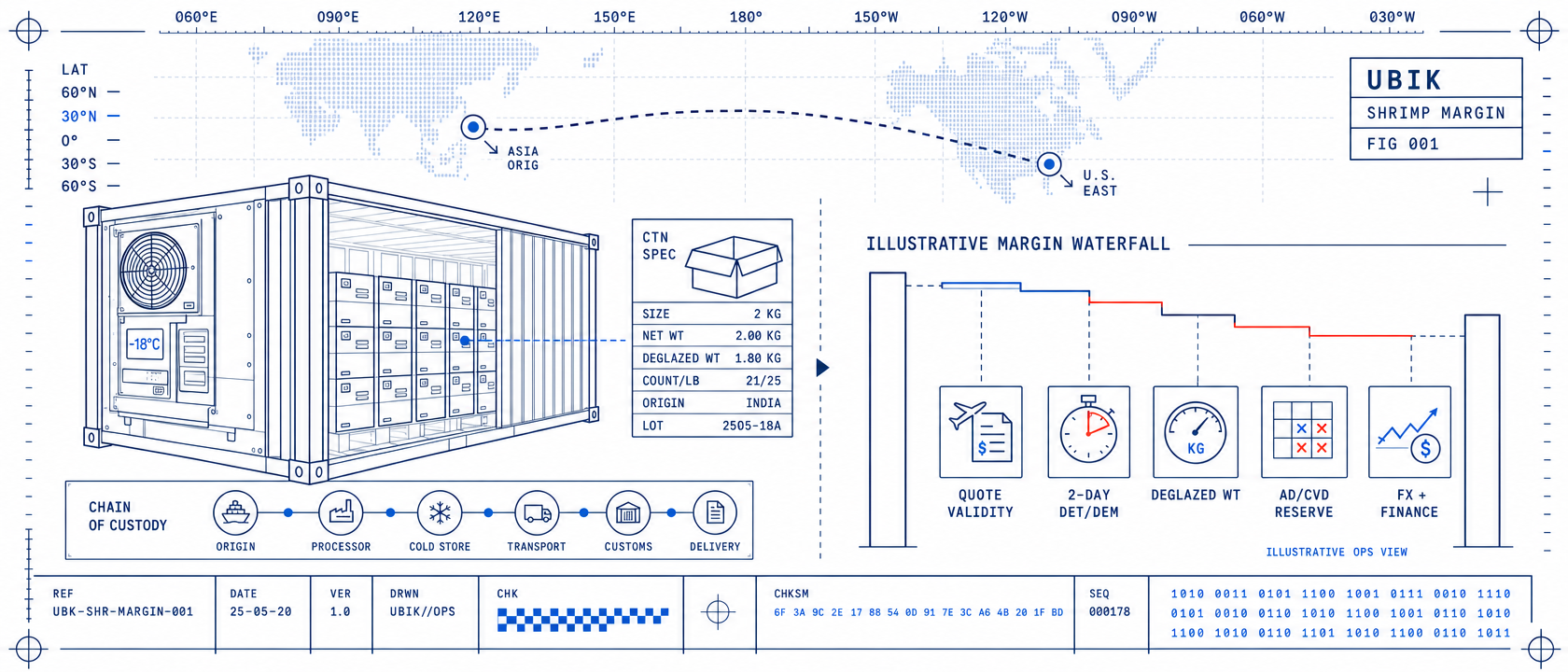
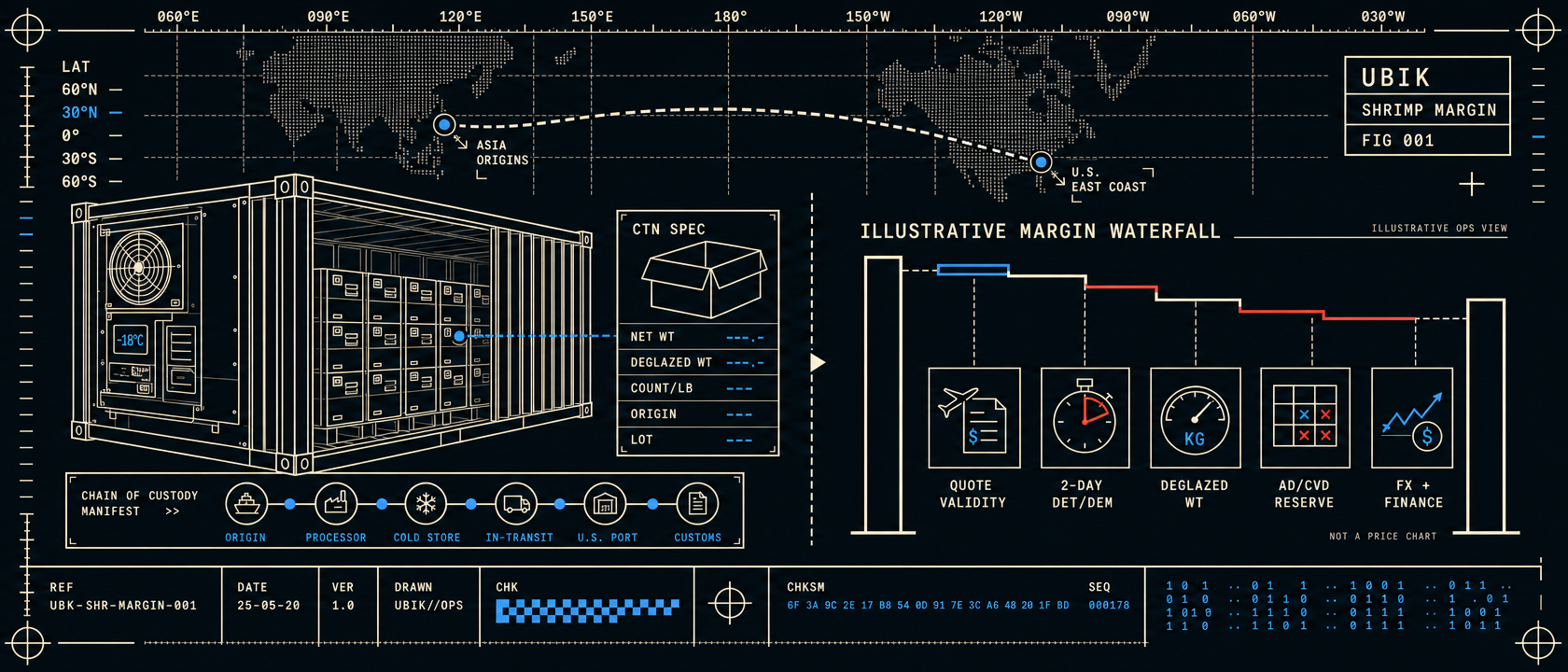
The market held up, the handoffs didn’t
The example is one anonymized 40-foot reefer of farmed vannamei, HLSO 21/25, ex-India to a U.S. East Coast buyer. Planned gross margin was 10.00 cents on the revenue dollar. The desk still leaked 60 basis points across ordinary execution nodes.
$220k
landed value in the anonymized example
10.00c
planned gross margin per revenue dollar
60 bps
quiet execution leakage before month-end
Active leak
-7 bps
9.93c margin left
RFQ intake delay
Auto-triage inbound RFQs and force a quote or no-bid inside five minutes.
Leak 01 / 11
RFQ intake delay
-7
bps
9.93c margin left. Auto-triage inbound RFQs and force a quote or no-bid inside five minutes.
01 / Commercial
-7 bps -> 9.93c
RFQ intake delay
A late first response rarely appears as a line-item loss. It shows up as weaker quote-to-order conversion or a trader haircuting price to win back credibility.
Control: Auto-triage inbound RFQs and force a quote or no-bid inside five minutes.
02 / Quality
-4 bps -> 9.89c
Counterparty scoring gap
Paper KYC can pass while harvest-event, label-weight, SIMP, or claims-history discipline is weak. The cost lands later as holds, rework, or destination credits.
Control: Score factories on trade behavior, not just registry documents.
03 / Finance
-6 bps -> 9.83c
FX timing
The trade looks commercially fine until INR, IDR, VND, EUR, or USD cash conversion lands. The error is treating FX as background noise after quote validity starts.
Control: Lock FX by rule at quote validity, not by trader memory.
04 / Logistics
-5 bps -> 9.78c
Freight reprice
Freight indexes are more normal than 2024, but still jumpy enough that fixed delivered prices can go stale between quote and booking.
Control: Tie quote validity to a live freight benchmark and reprice after trigger thresholds.
05 / Logistics
-8 bps -> 9.70c
Demurrage and detention
Two extra reefer days can beat the headline freight move. This is usually an elapsed-time failure, not a market-pricing failure.
Control: Run a container free-time burn-down monitor by box, terminal, appointment, hold, and consignee readiness.
06 / Quality
-4 bps -> 9.66c
Temperature deviation
Small frozen-chain excursions tend to become regrade and claim friction rather than a dramatic rejection. The right unit is degree-hours, not only max temperature.
Control: Write temperature claim language around degree-hours and attach logger evidence at shipment close.
07 / Quality
-7 bps -> 9.59c
Count-size slippage
Selling one count and receiving a meaningful tail of smaller material converts quietly into customer credits and commercial goodwill.
Control: Settle count on a post-thaw, deglazed sample protocol written into the PO.
08 / Quality
-6 bps -> 9.53c
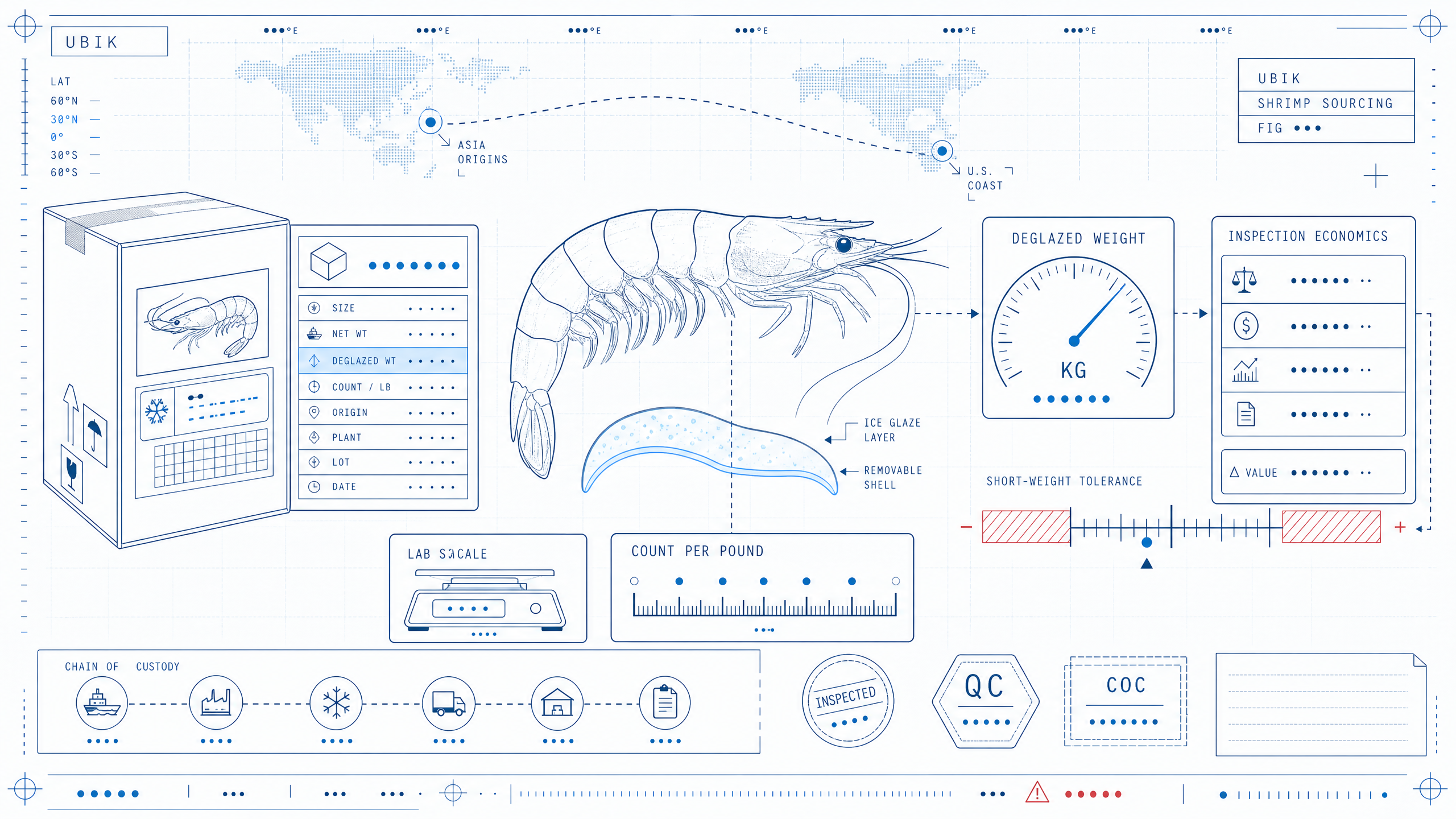
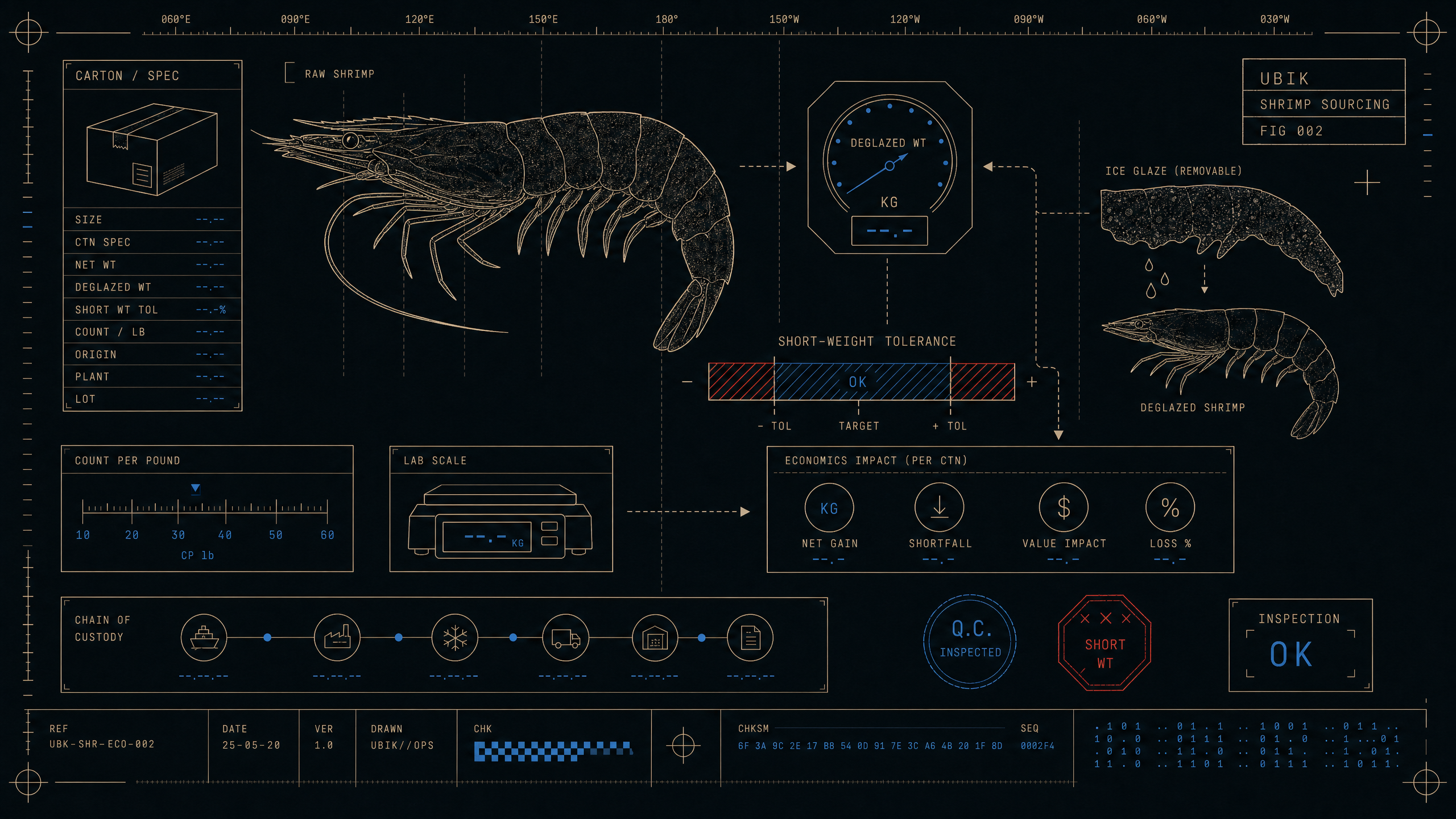
Glaze and moisture
Gross packed weight can hide the real economics. Short-weight and removable glaze turn a cheap supplier quote into a claim file.
Control: Normalize supplier quotes to deglazed net kilograms and test arrival samples the same way.
09 / Logistics
-4 bps -> 9.49c
Forwarder spread
This is not always fraud. It is often convenience tax: all-in buy rates drifting wide to public freight references without a variance reason.
Control: Store every forwarder quote against a live benchmark snapshot and variance note.
10 / Finance
-5 bps -> 9.44c
Working-capital carry
Finance cost is often booked below gross margin, which lets traders underprice tenor even when SOFR and local benchmarks are not zero.
Control: Quote product basis, freight basis, FX basis, and tenor basis separately.
11 / Policy
-4 bps -> 9.40c
Unclaimed remission or drawback
For India-linked trade, RoDTEP and drawback discipline matter because missed remission is usually priced away upstream or lost in filing.
Control: Reconcile export HS, remission eligibility, and filing status at shipment close.
Elapsed time beats headline freight
The counterintuitive leak is detention. Two extra reefer days can beat a week of freight movement on a $220k lot.
Deglazed weight is the real unit
Gross packed weight is not buyer economics. Quote comparison should normalize to deglazed net kilograms and count protocol.
Cash timing belongs in the quote
SOFR, local rates, FX timing, and customer tenor do not disappear because finance books them below gross margin.
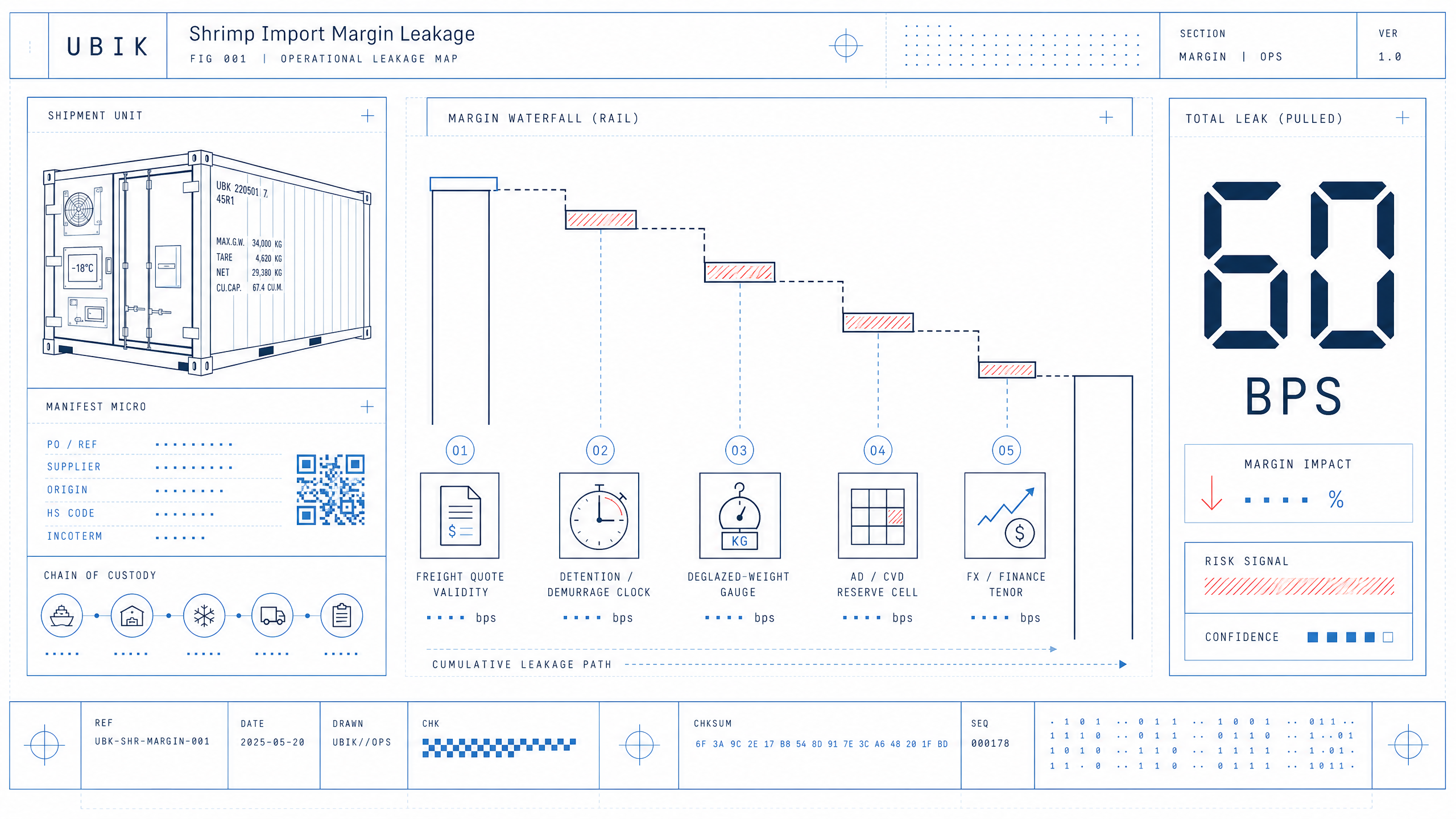
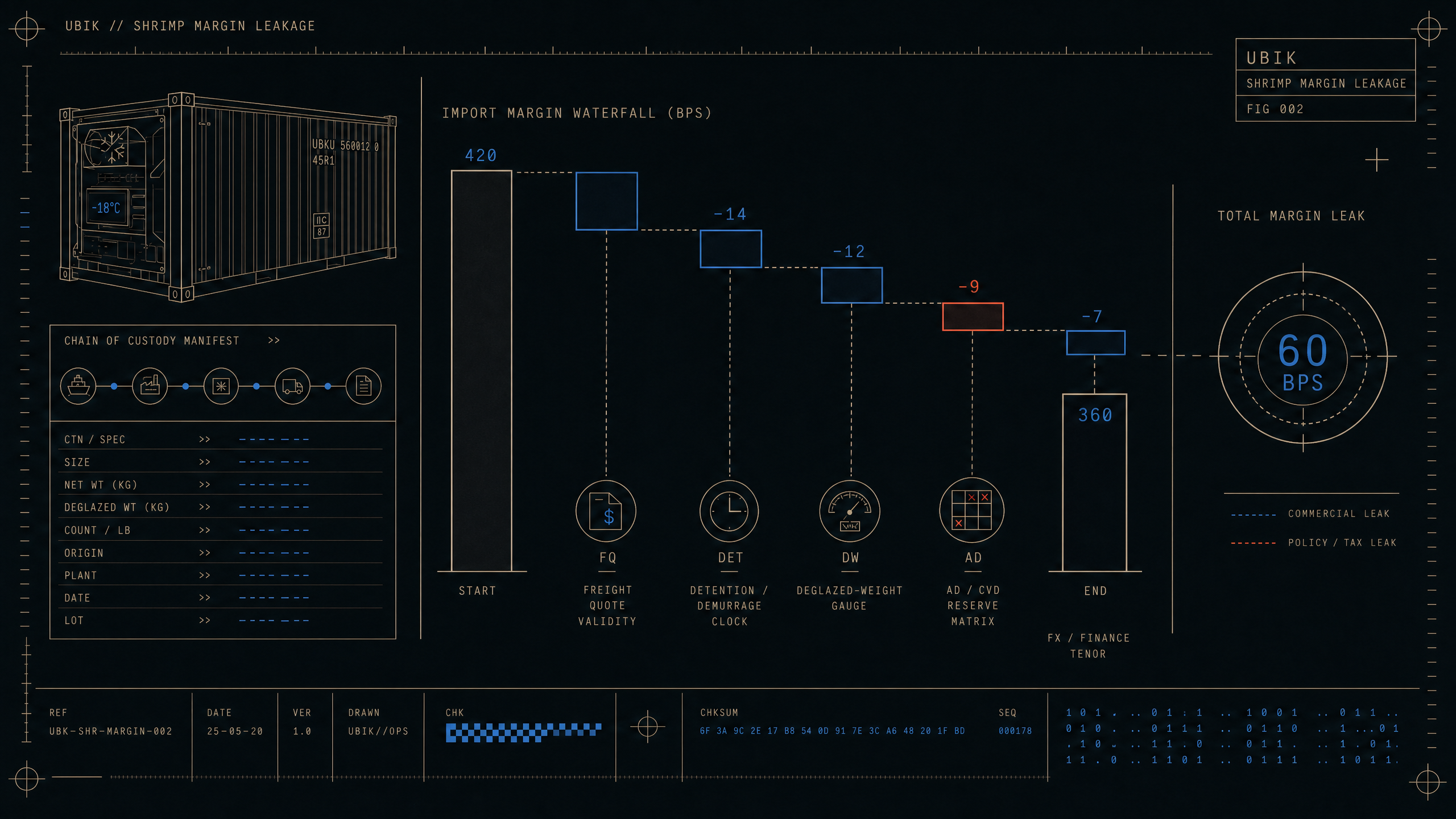
Where AI actually moves the needle
Not by calling next month’s shrimp price. The high-ROI work is dull: RFQ triage, HS-code guardrails, AD/CVD prompts, document consistency checks, count-size normalization, deglazed-weight claim prep, and free-time exception queues.
These are places where public data are structured and the leak is process variability. The AI job is to compress elapsed time and reduce clerical error. The trader still owns the market call.
PATCH 01
Five-minute RFQ operating rule
Pull last good spec, freight, FX basis, and approved counterparty state before the first human reply.
RFQ / FX / freight
PATCH 02
Spec-linked coding library
Make HS mapping a product attribute tied to cook state, breading, sauce, packing medium, destination, and remedy reserve.
classification / AD-CVD / remission
PATCH 03
Free-time burn-down screen
One box-level queue with terminal, free days left, appointment state, customs hold, and consignee readiness.
detention / claims
PATCH 04
Deglazed economics standard
Compare every offer on deglazed net kilograms, stated glaze, count protocol, and arrival-sample evidence.
count / glaze / short weight
PATCH 05
Finance basis on every quote
Show customer price, product basis, freight basis, FX basis, and tenor basis as separate operating facts.
FX / working capital
Source and limitation note
This note is an operating synthesis, not legal advice, customs guidance, or an audited industry benchmark. Public data are strongest on freight, remedies, port performance, standards, and short-weight enforcement; RFQ latency and counterparty leakage remain desk-estimate ranges.
Operating takeaway