



2026-05-07 / Food · Seafood / Buyer Strategy
Origin Roulette 2026: where shrimp is moving, and why
A trade-desk note for shrimp buyers resetting Q3 2026 and Q1 2027 books across tariffs, certification gates, disease risk, re-export exposure, and landed-cost arbitrage.
Trade-desk note / 7 May 2026
Buyer strategy for Q3 2026 and Q1 2027 books
Fifteen months ago, the shrimp desk carried three assumptions: the U.S. would take every kilo, Ecuador’s cost edge would narrow, and value-added processing was a side quest. All three broke. The origin mix now turns on tariff gates, certification depth, disease windows, and which product can clear the destination at the lowest landed cost with the least forward-book risk.
~6 Million MT
Rabobank estimate for 2025 farmed shrimp output, cited by FAO
231,804 MT
Ecuador to U.S. 2025 volume
0% base
Raw 0306.17 MFN duty; not the same as all-in landed duty
What changed since January 2025
India’s “U.S. shock” forced a real pivot. Exports diversified toward Vietnam, China, and Europe while farmers consolidated after the late-2025 price crash. The February 2026 U.S.-India reset lowered the reciprocal tariff pressure, but it did not erase the memory of a book that can become uneconomic overnight.
Ecuador converted the disruption into structural share. Its cost base still makes it the HLSO anchor, but China’s domestic production and inventory cycles increasingly decide whether Ecuadorian surplus stays absorbed or hits the U.S. and EU spot market.
Certification moved from nice-to-have to table stakes. BAP, ASC, antibiotic-free discipline, SIMP traceability, establishment approvals, import certification, forced-labour readiness, and CATCH/Annex IV where wild-caught inputs are involved are now commercial variables, not compliance footnotes.
The U.S. tariff read now needs a stack, not a single country number. Base MFN duty for many raw frozen shrimp lines is 0%, but temporary surcharge treatment, trade-framework implementation, AD/CVD cash deposits, China Section 301 exposure, and product carveouts can still change the cash cost at entry.
Ecuador
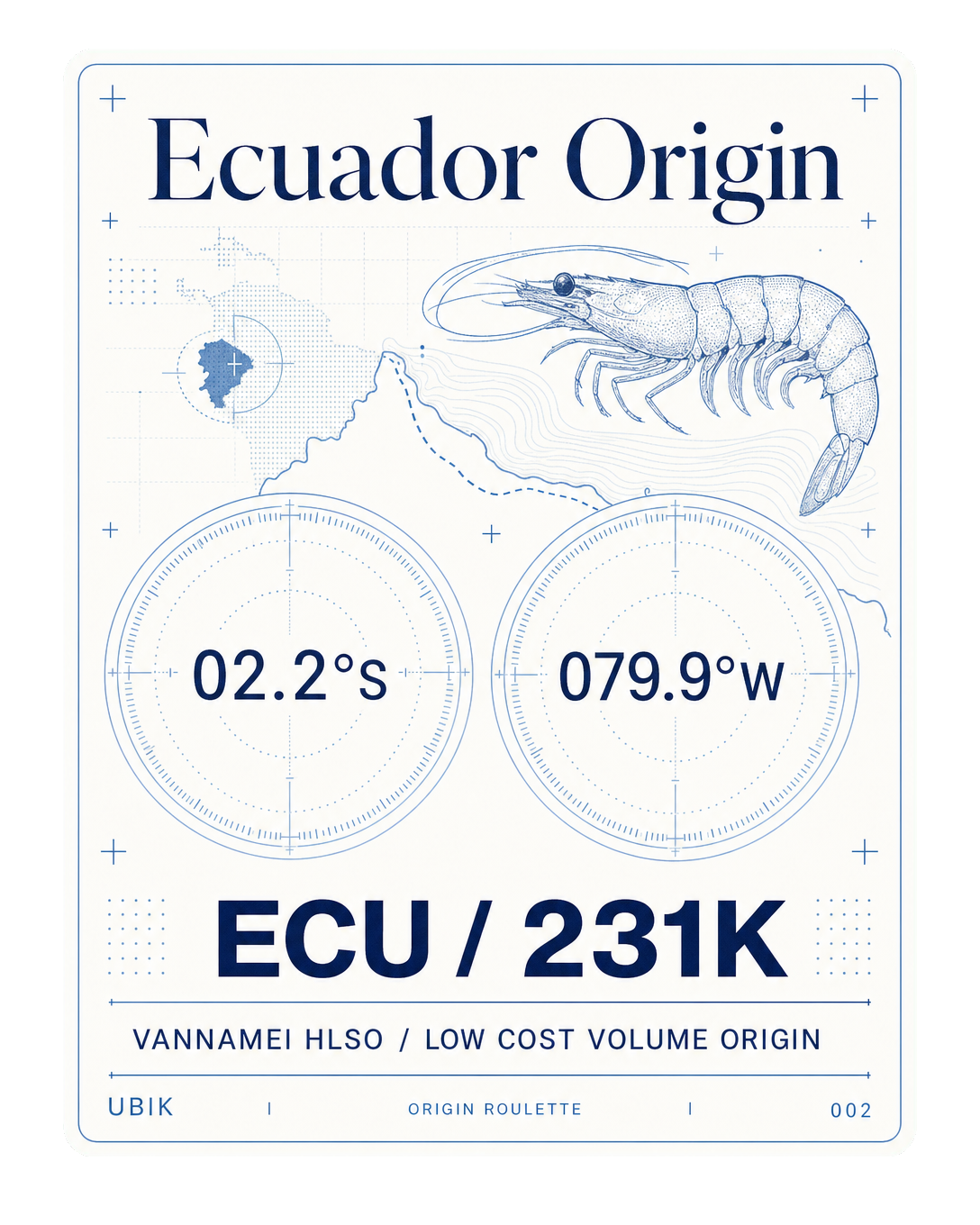
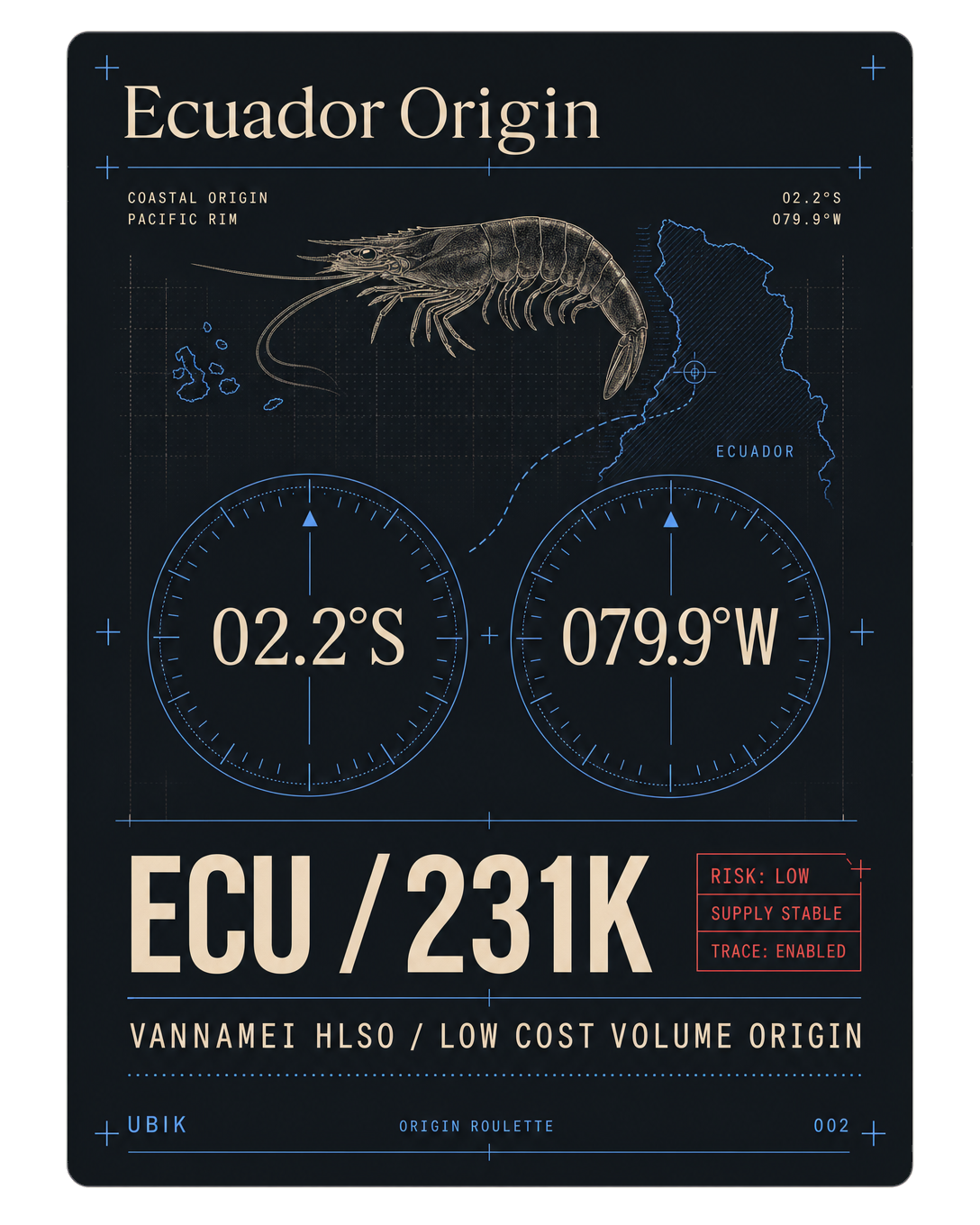
231,804 MT to the U.S. in 2025
Ecuador remains the structural volume leader in raw vannamei. The risk is not supply; it is oversupply spilling into U.S. and EU lanes, with spot prices softening when inventories rise.
Buy when: U.S. and EU HLSO contracts need lowest landed cost with BAP or ASC cover.
Avoid when: China destocking pushes too much Ecuadorian product into the same spot window.
Watch for: Section 122 / trade-deal carveouts, freight volatility, and dry-to-rainy disease windows.
U.S. stack: MFN Free for raw 0306.17; CVD 3.78%; Section 122 status separate.
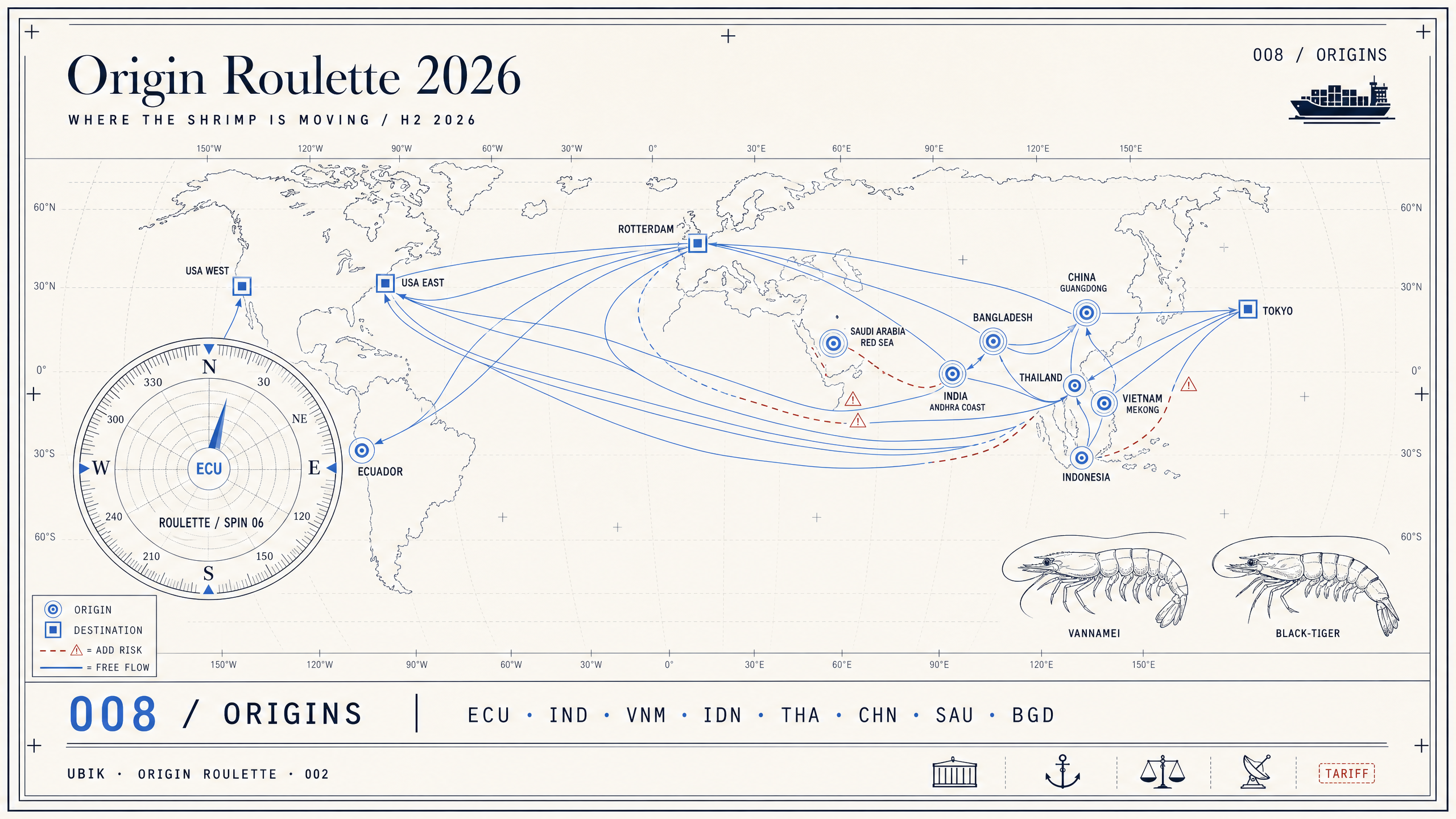
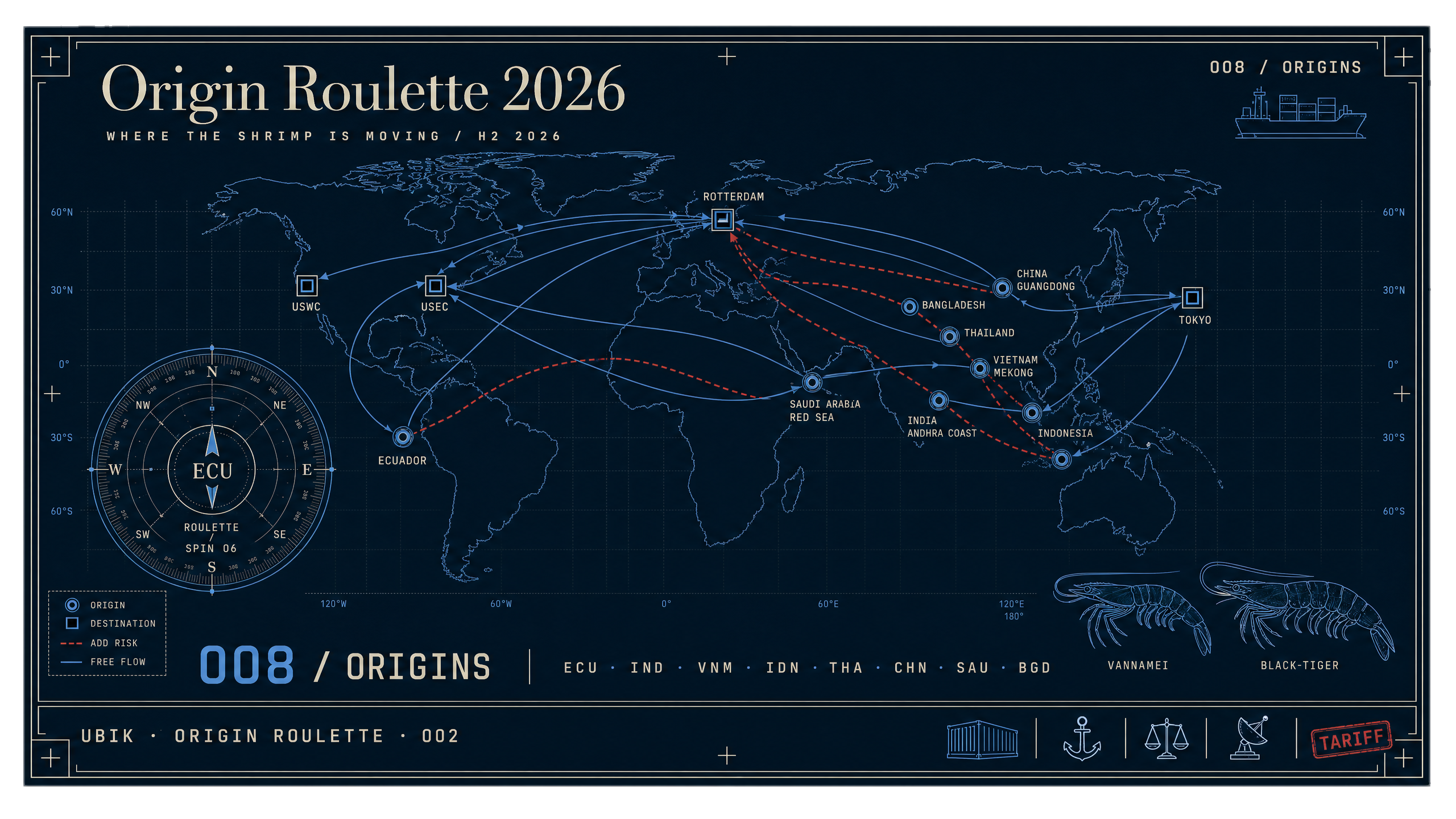
Country-by-country origin map
Ecuador and India are the two anchors, but for different reasons. Ecuador wins raw HLSO landed cost; India is the swing bet in cooked & value added products where tariff treatment and processing depth matter more than pond cost alone.
Vietnam remains the processing desk’s best friend and the compliance desk’s hardest conversation. Indonesia is a small convexity tranche if radiation certification and residue controls keep holding. Thailand is premium processing with labour scrutiny. China is the demand-side price floor. Saudi Arabia and Bangladesh are optionality, not base load.
Where the tonnage is moving
Landed-duty exposure by origin and market
| Origin | U.S. | EU | Japan | GCC |
|---|---|---|---|---|
| Ecuador | 0 + 10 + 3.78 MFN Free for raw 0306.17; Section 122 default modeled separately; CVD all-others 3.78%. | 5.5% | 3.5% | 5% |
| India | 18 + 5.77 18% framework reference; CVD all-others 5.77%; current Section 122 / HTS treatment separate. | 0% FTA path | 3.5% | 5% |
| Vietnam | 20 + 2.84 20% framework reference; CVD all-others 2.84%; company-specific 221.82% outlier risk. | 5.5% | 3.5% | 5% |
| Indonesia | 19 + 3.90 19% framework reference; AD all-others 3.90%; CVD de minimis; certification gates matter. | 5.5% | 3.5% | 5% |
| Thailand | 19% Framework-rate reference; labour and processor compliance can dominate the desk decision. | 5.5% | 3.5% | 5% |
| China | MFN + 301 + surcharge 10% is not all-in; China Section 301 reference list includes frozen and prepared shrimp headings. | 5.5% | 3.5% | 5% |
| Saudi Arabia | MFN Free + check No Saudi shrimp-specific 0% special-duty source verified; confirm Section 122 / HTS status. | 0% | 3.5% | 0% |
| Bangladesh | 19% White House framework reference is 19%; product carveout status still needs HTS-line confirmation. | 0% | 3.5% | 5% |
Updated 18 May 2026; U.S. cells are modeled as duty stacks, not single country tariffs. Base MFN duty can be 0% for common raw frozen shrimp lines, while Section 122 status, trade-framework implementation, AD/CVD cash deposits, China Section 301 exposure, and product-specific carveouts can still change importer cash cost.
Origin optimisation for specific books
| Species | Count | End-market | Window | Certification | Optimal origin | Rationale |
|---|---|---|---|---|---|---|
| Vannamei | 16/20 | U.S. foodservice HLSO | Q3 2026 spot | BAP 2-star | Ecuador primary, India secondary | Tariffs and landed cost dominate the spot window; Ecuador anchors price, India fills after the rate reset. |
| Vannamei | 21/25 | EU retail cooked tail-on | Q3 2026 book | ASC, CATCH, FLR traceable | India primary, Vietnam backup | India’s value-added tariff path is the margin play; Vietnam remains the processing backup with IUU delay risk. |
| Vannamei | 21/25 | Saudi/UAE value pack | Q3 2026 book | Halal | Saudi Arabia premium, India cost, Ecuador fill | Saudi origin removes halal documentation friction; India and Ecuador need third-party certification support. |
| Vannamei | 31/40 | EU retail value pack | Q1 2027 forward | ASC, FLR, organic | Ecuador price, India FTA | Ecuador protects HLSO floor price; India protects cooked/breaded regulatory trajectory. |
| Black tiger | U-10 | Japan sushi/tempura | Q3 2026 spot | MAFF residue cert | Vietnam, India, Bangladesh niche | Vietnam wins tempura capability; India covers block-frozen; Bangladesh is a QA-led specialty play. |
The decision rule
For Q3 2026 spot, tariffs and landed cost dominate. Ecuador and India carry most of the book, with Indonesia used only as a certified diversifier and Vietnam reserved for processing-heavy lines.
For Q1 2027 forward books, the discriminator shifts to regulatory trajectory. Establishment approvals, residue control, SIMP expansion, forced-labour readiness, AD/CVD reviews, and CATCH or Annex IV documentation where wild-caught inputs are involved matter more than a temporary spot discount.
BET 01
India cooked 21/25 for EU retail beats Ecuadorian HLSO on margin
The India-EU tariff path and value-added processing depth create a better net-back story than raw HLSO. The risk is not the thesis; it is processor-level residue control and backup qualification.
BET 02
Indonesia is the convex U.S. diversifier if certification holds
If radiation certification, residue discipline, and ADD review outcomes stay clean, Indonesia can undercut Ecuador on certain U.S. HLSO books. Position it as a small tranche, not the core book.
BET 03
30-count vs 60-count decides India vs Ecuador
For large 30-count raw material, Ecuador’s farm-gate advantage can be decisive when the India-Ecuador gap closes. On 60-count, the gap is tighter, so India can still compete when processors protect margin through forex, cooked yield, and value-added conversion.
Disease risk to watch
Indonesia’s Java and Lampung recovery remains fragile, while Ecuador’s seasonal dry-to-rainy transition keeps Vibrio and WSSV on the stocking-density watchlist.
Regulatory tripwire
IEEPA-style tariff suspensions, ADD/CVD reviews, and EU forced-labour readiness can change landed cost faster than farm-gate price moves.
Where Vietnam re-export rules bite
HS 1605 entries need raw-material traceability, not only processing-country paperwork. The exact document set depends on whether the input is wild-caught or farmed.
Pressure-testing conventional wisdom
Ecuador will keep undercutting India on price.
True for HLSO, weaker for cooked. Ecuador keeps the raw-material cost edge, but India’s cooked and breaded processing depth plus the EU FTA path changes the landed-cost math.
The U.S. stays the highest-margin shrimp market.
Still true in some foodservice windows, but less automatic. Tariffs, cash deposits, and weaker U.S. import demand make EU cooked programs newly competitive.
Vietnam’s IUU yellow card does not matter for shrimp.
It matters commercially for seafood-risk perception and wild-caught or processed wild inputs. For farmed vannamei, the tighter issues are residue control, establishment approvals, and raw-material traceability.
Source and limitation note
This note is a buyer-strategy synthesis, not legal advice or a live customs ruling. Tariffs, ADD/CVD cash deposits, import alerts, and certification requirements can change without matching the cadence of public trade articles.